Know the opposing
economist. Before the report lands.
Supreme Mind simulates the opposing damages expert: the likely opinion, cross-examination weaknesses, Daubert challenges to the model, and a settlement range for cartel, overcharge, and monopolization matters, built from the public record.
Individual simulations are $50 each. Example cases are free on a firm email address, and firms run on credit plans with volume pricing. See pricing.
Antitrust turns on the economists. The fight is the damages model: overcharge, cost pass-through, and class-wide impact.
Industrial-organization experts run six figures, and the case often lives or dies on the regression. You need to see the methodology attack early: the specification the opposing economist will use, where it is vulnerable under Daubert, and how common impact holds up under Comcast, not after the rebuttal report lands. Supreme Mind returns that analysis in minutes for $50 per simulation, so the trial team can pressure-test the model before it is served. The credentialed human still testifies; the first weeks of preparation do not have to wait.
The Exposure & Settlement Brief.
Four sections. One simulation.
Every supporting quote is verified against the public record.
The damages theory.
The reduced-form or structural specification the economist would run, the benchmark and pass-through assumptions it would defend, and the but-for overcharge it would put to the jury, in its own voice.
Where the model breaks.
Omitted-variable and demand-shock problems. Benchmark contamination. Pass-through assumed uniform across a heterogeneous class. Ordered by leverage, each cited to the case file and the expert's prior record.
The Daubert attack surface.
FRE 702 vectors on regression specification and pass-through assumptions, and common impact under Comcast v. Behrend. Where the expert's prior methodology has been challenged or excluded, the controlling ruling is cited.
Overcharge × affected commerce.
Overcharge applied to affected commerce, trebling noted, uncertainty stated. If common impact fails under Comcast, what happens to class exposure? A partner-economics input, not a court-facing prediction.
One brief, four sections, side by side.
Real screens from the In re Lithium Ion Batteries run (MDL 2420, N.D. Cal.), generated from the direct-purchaser complaint. Export to Word, a Daubert-motion skeleton, or a deposition outline from the same page.
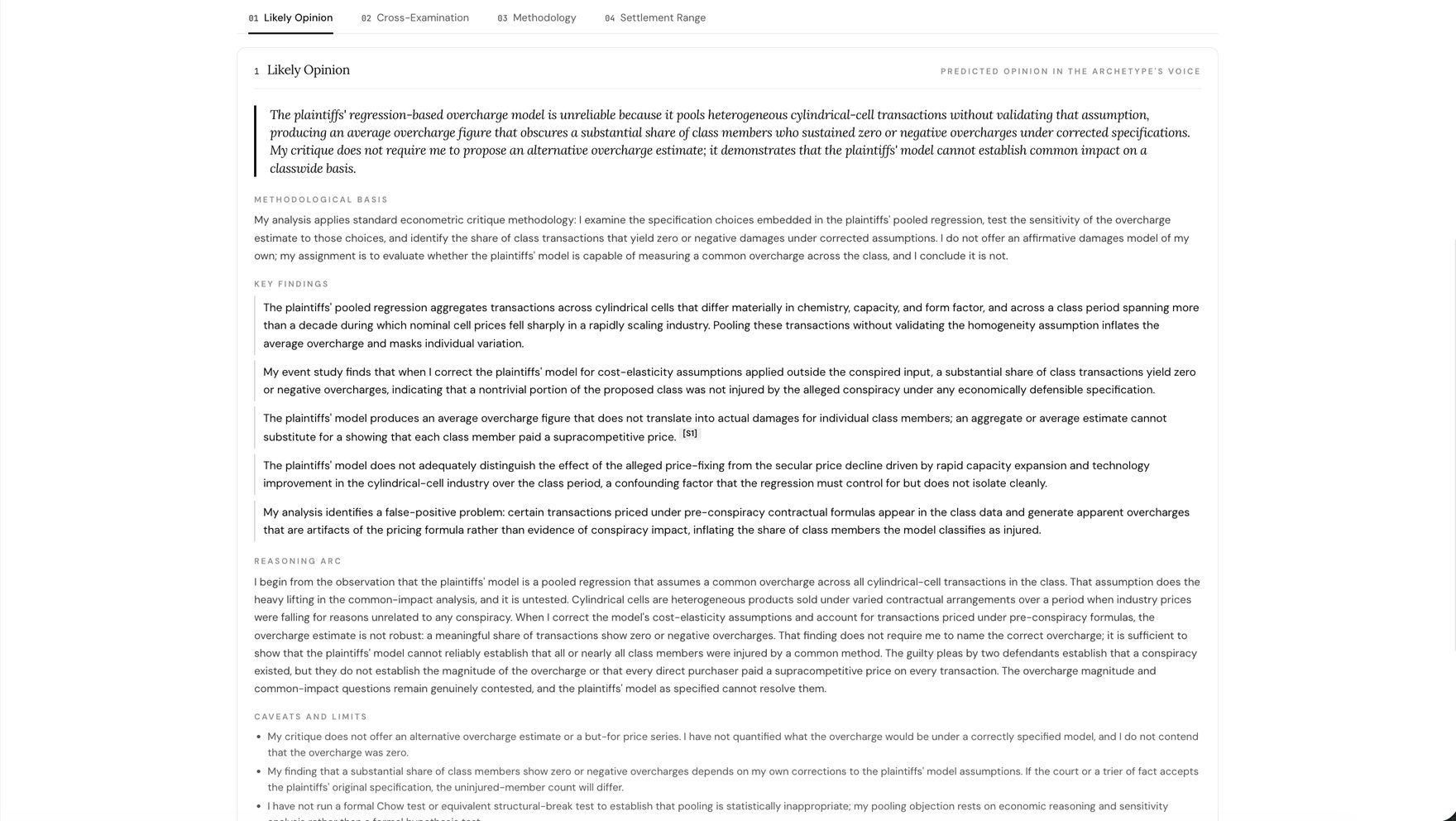
The critique the defense cartel econometrician will offer, in their own voice, with the caveats they would state themselves: no alternative overcharge estimate, no formal pooling test.
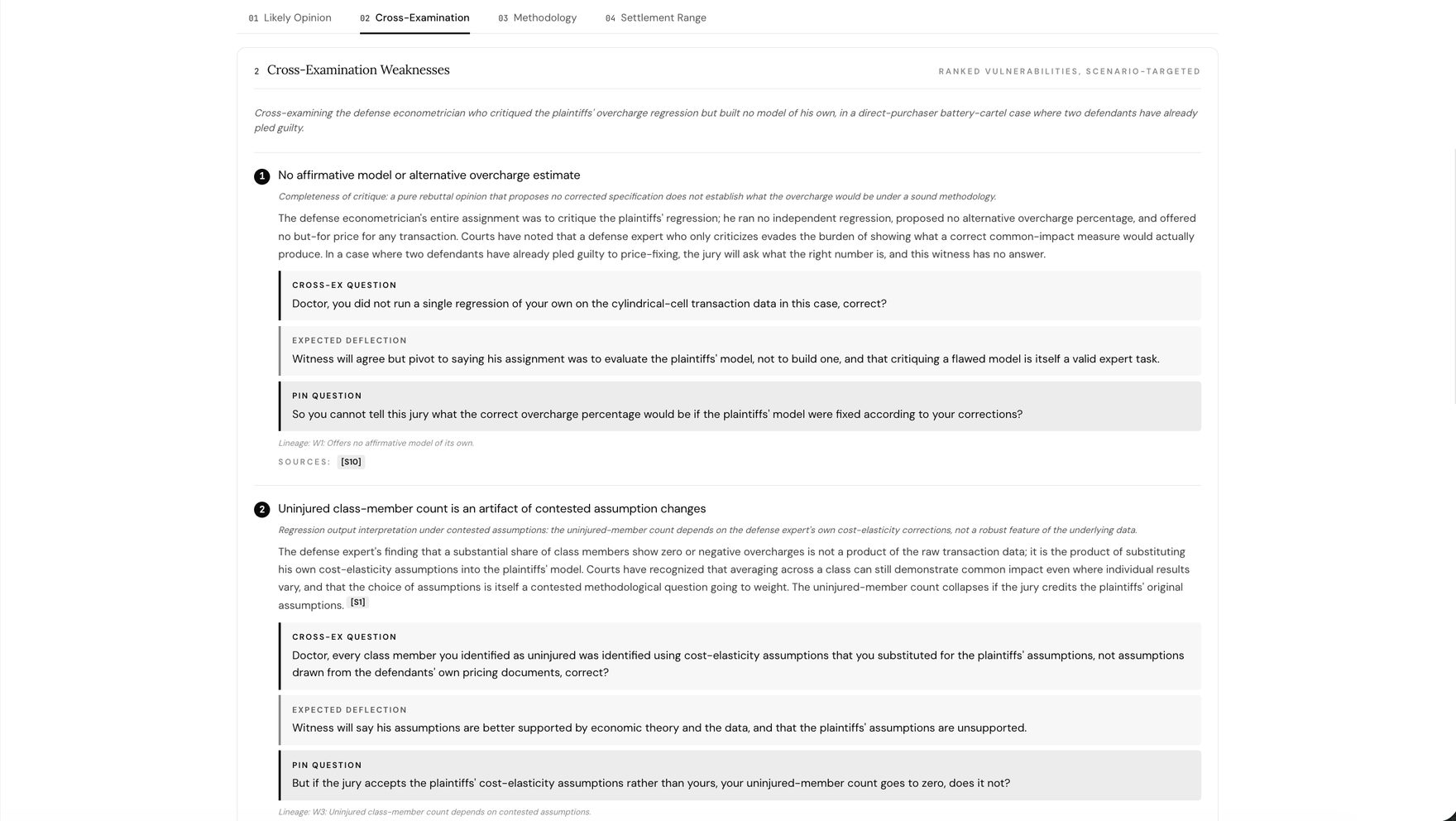
Ranked weaknesses. Each carries the question to ask, the deflection to expect, and the pin question behind it, with the lineage of the finding shown.
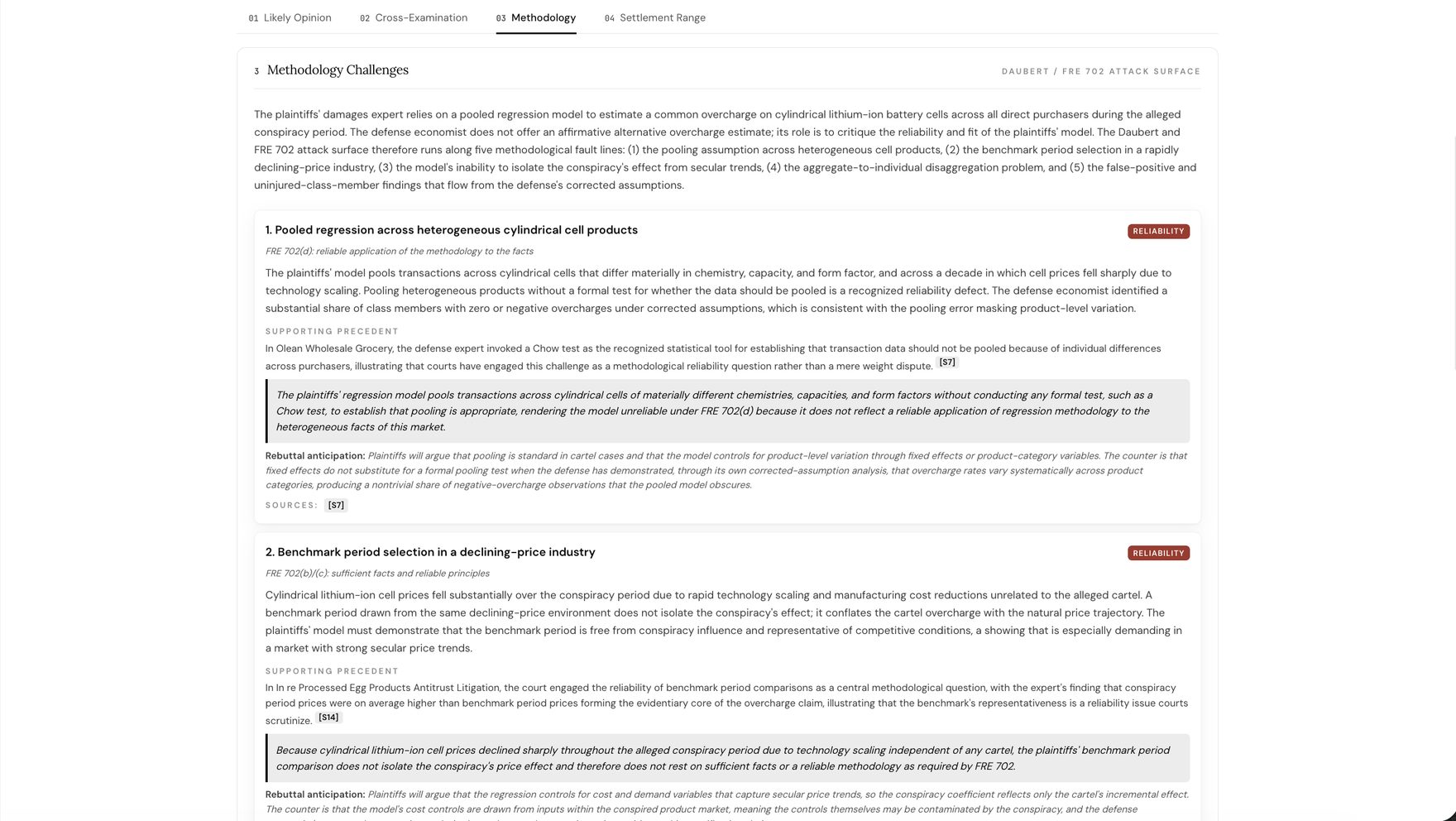
Five Rule 702 fault lines, each tagged fit or reliability, each with the precedent that engaged it and the rebuttal to anticipate.
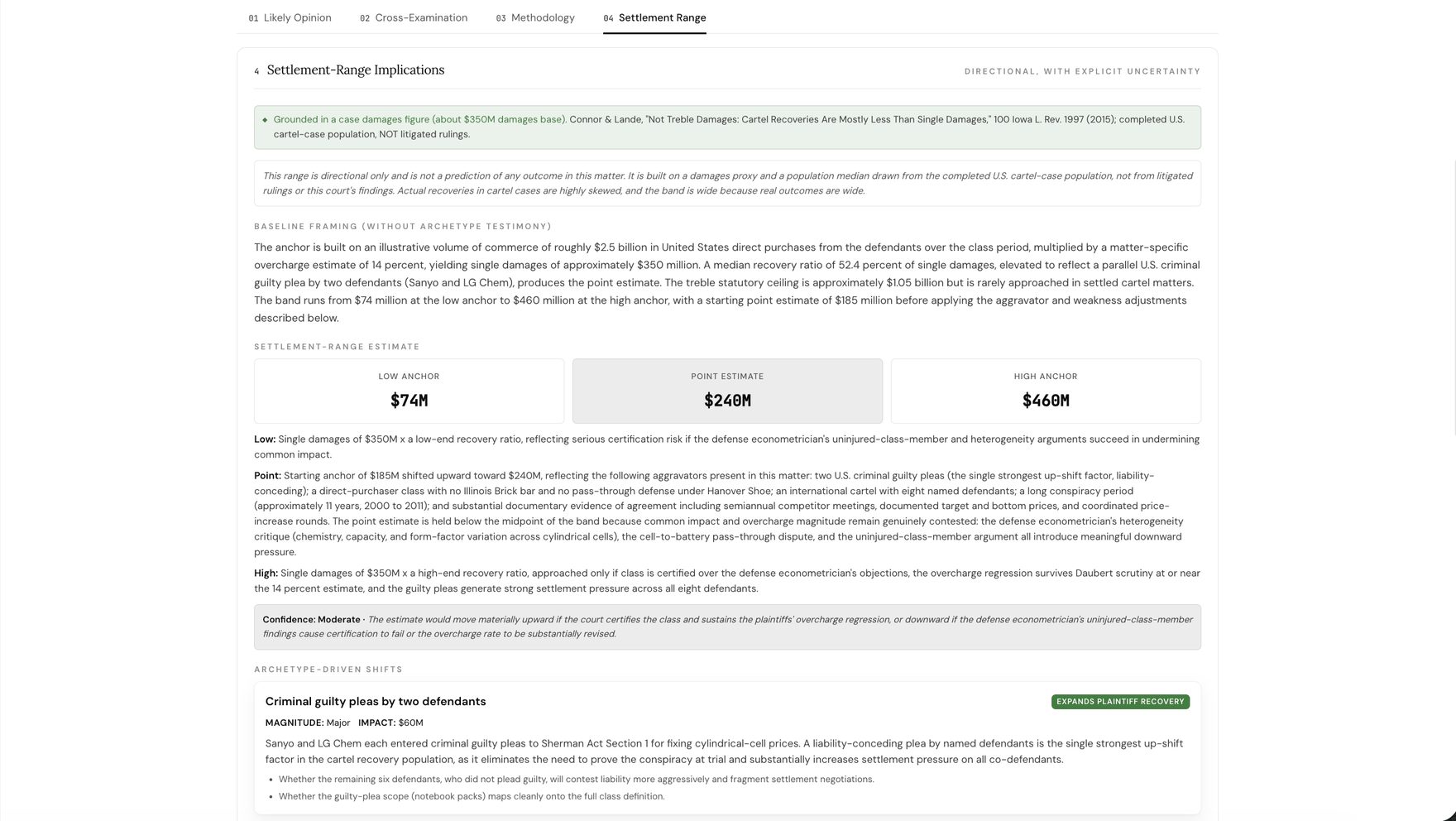
Low, point and high anchors against a damages base, with every driver priced and directional, and the uncertainty stated in the brief rather than buried.
Screens are from a worked public-record example case, which is why the product marks it as an example with a known outcome and offers to score itself against what actually happened.
Read the brief itself.
From the Lithium Ion Batteries run. Every citation opens the full opinion on CourtListener, which is where the run checked it before writing it down.
Likely Opinion
Predicted opinion in the expert's voiceThe plaintiffs' regression-based overcharge model is unreliable because it pools heterogeneous cylindrical-cell transactions without validating that assumption, producing an average overcharge figure that obscures a substantial share of class members who sustained zero or negative overcharges under corrected specifications. My critique does not require me to propose an alternative overcharge estimate; it demonstrates that the plaintiffs' model cannot establish common impact on a classwide basis.
My analysis applies standard econometric critique methodology: I examine the specification choices embedded in the plaintiffs' pooled regression, test the sensitivity of the overcharge estimate to those choices, and identify the share of class transactions that yield zero or negative damages under corrected assumptions. I do not offer an affirmative damages model of my own; my assignment is to evaluate whether the plaintiffs' model is capable of measuring a common overcharge across the class, and I conclude it is not.
Pooling across heterogeneous products inflates the average
The plaintiffs' pooled regression aggregates transactions across cylindrical cells that differ materially in chemistry, capacity, and form factor, and across a class period spanning more than a decade during which nominal cell prices fell sharply in a rapidly scaling industry. Pooling these transactions without validating the homogeneity assumption inflates the average overcharge and masks individual variation.
A substantial share of the class shows no injury under corrected assumptions
My event study finds that when I correct the plaintiffs' model for cost-elasticity assumptions applied outside the conspired input, a substantial share of class transactions yield zero or negative overcharges, indicating that a nontrivial portion of the proposed class was not injured by the alleged conspiracy under any economically defensible specification.
An average overcharge is not a showing of individual injury
The plaintiffs' model produces an average overcharge figure that does not translate into actual damages for individual class members; an aggregate or average estimate cannot substitute for a showing that each class member paid a supracompetitive price.
The model does not separate the cartel from the secular price decline
The plaintiffs' model does not adequately distinguish the effect of the alleged price-fixing from the secular price decline driven by rapid capacity expansion and technology improvement in the cylindrical-cell industry over the class period, a confounding factor that the regression must control for but does not isolate cleanly.
Legacy contract pricing generates false positives
My analysis identifies a false-positive problem: certain transactions priced under pre-conspiracy contractual formulas appear in the class data and generate apparent overcharges that are sections of the pricing formula rather than evidence of conspiracy impact, inflating the share of class members the model classifies as injured.
Reasoning arc
I begin from the observation that the plaintiffs' model is a pooled regression that assumes a common overcharge across all cylindrical-cell transactions in the class. That assumption does the heavy lifting in the common-impact analysis, and it is untested. Cylindrical cells are heterogeneous products sold under varied contractual arrangements over a period when industry prices were falling for reasons unrelated to any conspiracy. When I correct the model's cost-elasticity assumptions and account for transactions priced under pre-conspiracy formulas, the overcharge estimate is not robust: a meaningful share of transactions show zero or negative overcharges. That finding does not require me to name the correct overcharge; it is sufficient to show that the plaintiffs' model cannot reliably establish that all or nearly all class members were injured by a common method. The guilty pleas by two defendants establish that a conspiracy existed, but they do not establish the magnitude of the overcharge or that every direct purchaser paid a supracompetitive price on every transaction. The overcharge magnitude and common-impact questions remain genuinely contested, and the plaintiffs' model as specified cannot resolve them.
Caveats and limits, stated by the witness
The expert states its own vulnerabilities before opposing counsel does, which is what makes the cross-examination section that follows worth reading:
- My critique does not offer an alternative overcharge estimate or a but-for price series. I have not quantified what the overcharge would be under a correctly specified model, and I do not contend that the overcharge was zero.
- My finding that a substantial share of class members show zero or negative overcharges depends on my own corrections to the plaintiffs' model assumptions. If the court or a trier of fact accepts the plaintiffs' original specification, the uninjured-member count will differ.
- I have not run a formal Chow test or equivalent structural-break test to establish that pooling is statistically inappropriate; my pooling objection rests on economic reasoning and sensitivity analysis rather than a formal hypothesis test.
- Whether my critiques go to the admissibility of the plaintiffs' model or only to its weight at the certification hearing is a legal question for the court; I express no opinion on that question.
- The opinions I rely on for methodological benchmarks were decided before the December 1, 2023 amendment to Federal Rule of Evidence 702, which clarified that the proponent must establish admissibility by a preponderance of the evidence; their precedential weight on admissibility questions is therefore somewhat reduced.
The recorded output of a real run on the public record, in full. Citations open the passage the run relied on, checked against the opinion text on CourtListener.
See the full antitrust run →Put him on the stand before the deposition.
Doctor, did you run any regression of your own on the cylindrical-cell transaction data?
No. My assignment was to evaluate the plaintiffs' model, not to construct an alternative one.
A class of expert, never a named individual. Nothing here is filed or offered as testimony.
Matter-first. One brief, grounded in the record.
The deliverable is the Exposure & Settlement Brief: four sections, every supporting quote verified against the public record.
Create a matter
Set up the case and upload documents. The file is extracted and available to the analysis.
Add experts
Add one or more de-identified experts: the opposing expert, or your own retained expert.
Ground it
Ground the analysis in a real cost pass-through (conspiracy-period prices compared to cost-predicted levels on public FRED input-cost series) plus extraction from your uploaded case documents.
Generate the brief
Produce the Exposure & Settlement Brief: likely opinion, cross-examination weaknesses, methodology challenges (Daubert / FRE 702), and settlement-range implications.
Verbatim citation verification
Every supporting quote is checked verbatim against public-record sources. Quotes that cannot be verified are dropped, not guessed.
Cross-examination practice simulation
Rehearse the exchange against the expert before the deposition: question, answer, follow-up.
Examine the record
Put a question to the case file, the complaint, the opposing report, the brief, and get an answer cited to the page, read as the opposing expert would. When the record is silent, it says so instead of guessing.
Expert-report stress test
Attack an opposing report for its weak points, or red-team your own retained expert's draft before it is served.
Exports built for the file
Export to Word, a Daubert-motion outline, and a cross-examination outline, plus PDF, copy, and email. Deliverable history is retained.
Named-expert overlay
Where warranted, optionally overlay a specific expert's public judicial record. Admin-controlled, not on by default.
The economists who decide antitrust cases. De-identified.
Antitrust cases run through a handful of economist types: cartel and common-impact, overcharge and pass-through, monopolization and market-definition, merger effects, and industrial organization. Each expert is a de-identified composite of public-record antitrust economists, anchored to documented methods and prior testimony. Never a named individual. The defense cartel econometrician is live today and can be run against your matter now. “In build” means the expert type is on the roster and not yet built. A firm with a matter in flight can move one up the queue.
Public record. Real data. Defined scope.
Each expert is a probabilistic synthesis of how a class of antitrust economist testifies, anchored to the public record. The differentiator is grounding: a real cost pass-through analysis comparing conspiracy-period prices to cost-predicted levels on public FRED series, plus extraction from your uploaded case documents.
- Cost pass-through grounding on public FRED input-cost series: conspiracy-period prices versus cost-predicted levels
- Document upload & extraction from the case file, available to the analysis
- Prior expert reports filed in publicly-docketed cases via PACER, RECAP, Bloomberg Law, Westlaw
- Prior deposition and trial testimony through court filings and commercial transcript databases
- Peer-reviewed academic publications for the academic-testifier subset
- Daubert briefing and rulings that have addressed the methodology, including Comcast v. Behrend common-impact analysis
- Practitioner publications from NERA, Cornerstone, and Brattle antitrust economists
Supreme Mind never represents an expert as being a real person. Every expert is an expert-class persona, deliberately bounded to the public record.
The same thirty days, spent on argument instead of waiting.
Rule 26(a)(2)(D) gives you 30 days to rebut a served expert report. Nothing moves that deadline: not the discovery stay, not the court’s calendar, not us. What changes is how much of the window is left once you understand what you are answering.
- Retaining an expert for the first read · 18 days · $25,000 to $45,000
- Drafting · 7 days
- Moot · 5 days
You reach the moot with a first draft.
- The same read, simulated · Minutes, on day zero
- Building and testing the cross against the economist · 20 days
- Rehearsed moot, then file · 10 days
The first read arrives on day zero, in minutes. You still read the report yourself. What you no longer wait weeks for is an expert telling you where it is weak.
Built for privileged work. Confidentiality is the product.
Matter content is handled as privileged material end to end: where it runs, where it is stored, and what is ever written to a log.
Passwordless sign-in
Magic-link sign-in tied to a named person: a one-time link to a work email. No password to phish or manage.
Firm accounts & admin
Firm accounts with a firm-admin role and self-service team management across multiple devices.
Server-side model
The model runs server-side. The browser never holds an API key.
US-pinned, Zero-Data-Retention
Inference is US-pinned and routed only through Zero-Data-Retention-eligible endpoints. Matter content is not used to train third-party models.
Per-firm US-region isolation
Per-firm data isolation in a US-region database; uploaded documents in a US-region store.
Metadata-only audit; 30-day deletion
Metadata-only audit logging; privileged content is never logged. Deleted matters are removed after a 30-day recovery window.
Pilots add SSO, RBAC, immutable audit logging, and a signed Anthropic data processing addendum (DPA) plus Zero-Data-Retention addendum.
Start on one named matter. Thirty days.
We are opening a small number of first matters with senior trial partners at antitrust and competition practices. One named matter, your choice. Public-record data only, grounded on public FRED series. Direct line to the founding team throughout.