Decades of securities
expertise. In minutes.
A ten-expert library spanning event-study econometrics, forensic accounting, fairness opinions, governance, and pay economics. The defense event-study econometrician and the valuation and fairness-opinion economist are live today; the rest are in build behind them. Each simulation returns a brief: likely opinion, cross-examination weaknesses, methodology challenges, settlement-range implications.
Individual simulations are $50 each. Example cases are free on a firm email address, and firms run on credit plans with volume pricing. See pricing.
Frontier AI has compressed the cost of PhD-class reasoning by two orders of magnitude. The securities expert-witness market has not adapted yet. Supreme Mind is the adapter.
The brief a senior expert produces in the first weeks of an engagement (likely opinion in the expert's voice, ranked cross-examination weaknesses, methodology challenges keyed to controlling case law, and settlement-range implications) is now generable in minutes for $50 per simulation. Trial teams that adopt the brief first get the structural advantage. Defense or plaintiff. The court still requires a credentialed human at deposition and trial; that part of the workflow stays human. The strategic read that precedes it no longer has to wait for a retention.
The brief.
Four outputs. One simulation.
The brief a senior expert builds across the first weeks of an engagement. Every supporting quote is verified against the public record.
One brief, four sections, side by side.
Real screens from the In re Luckin Coffee run, generated from the public docket. Export to Word, a Daubert-motion skeleton, or a deposition outline from the same page.
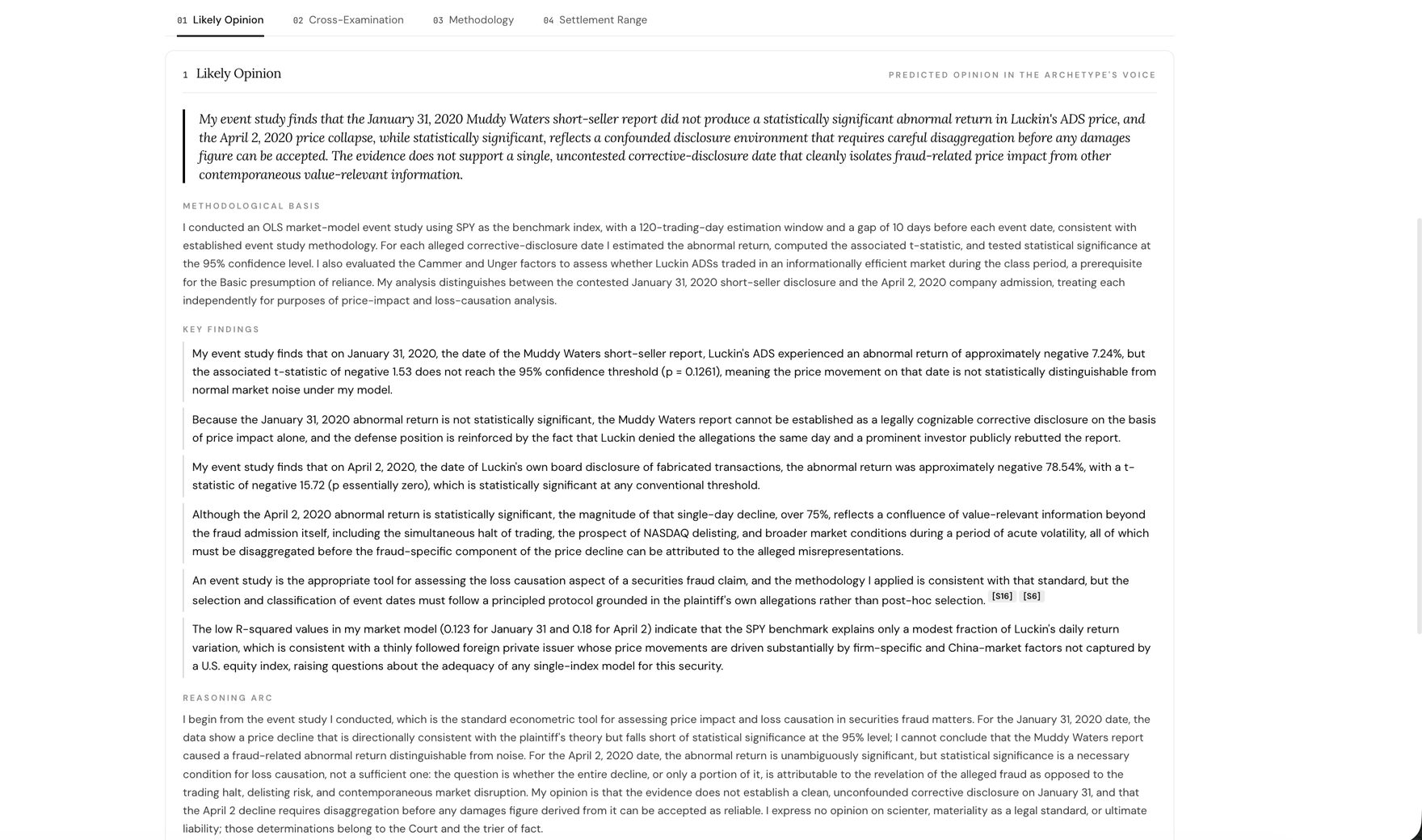
The opinion the opposing expert will offer, in their own voice: methodological basis, key findings, reasoning arc, and the caveats they would state themselves.
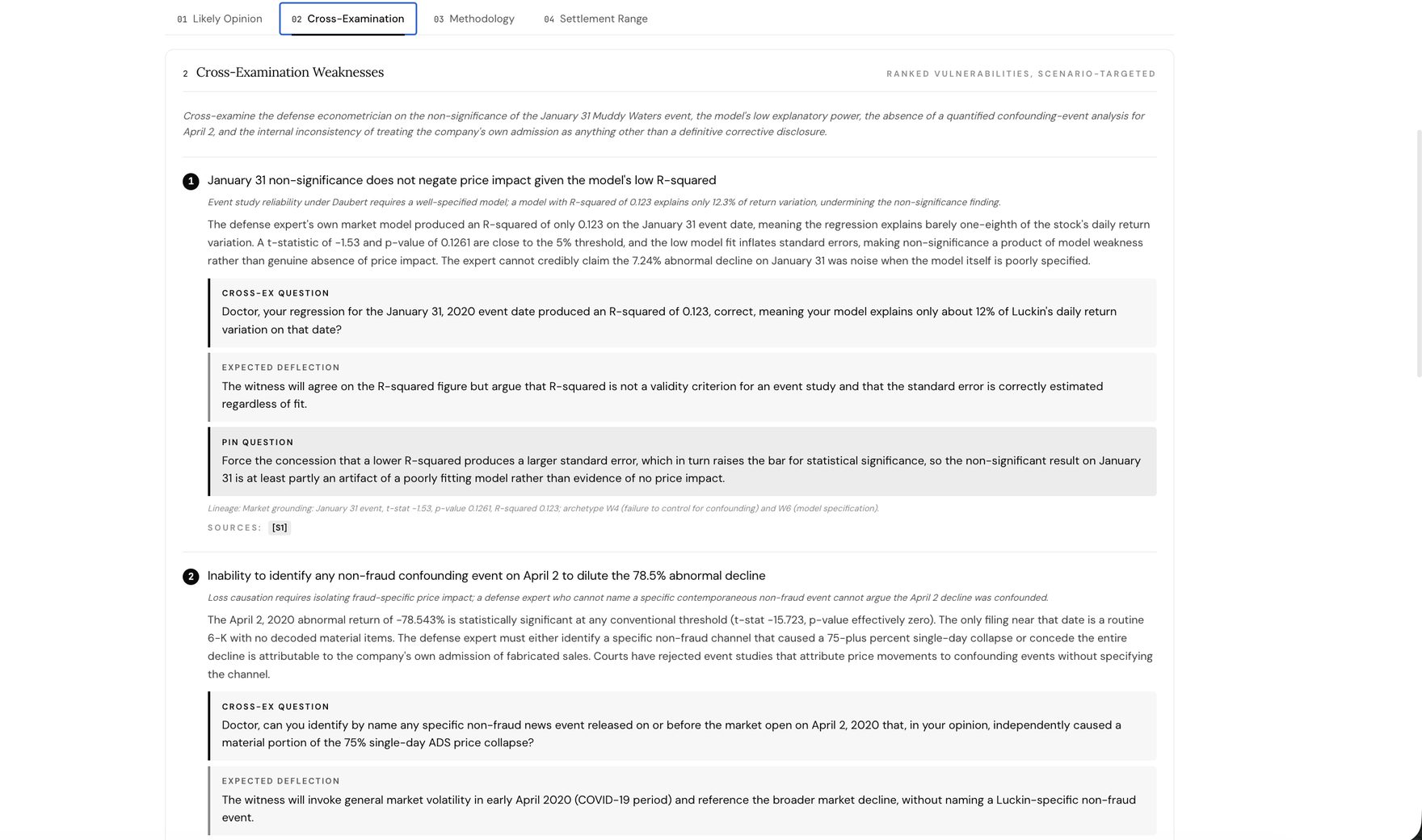
Ranked weaknesses. Each carries the question to ask, the deflection to expect, and the pin question behind it, with the lineage of the finding shown.
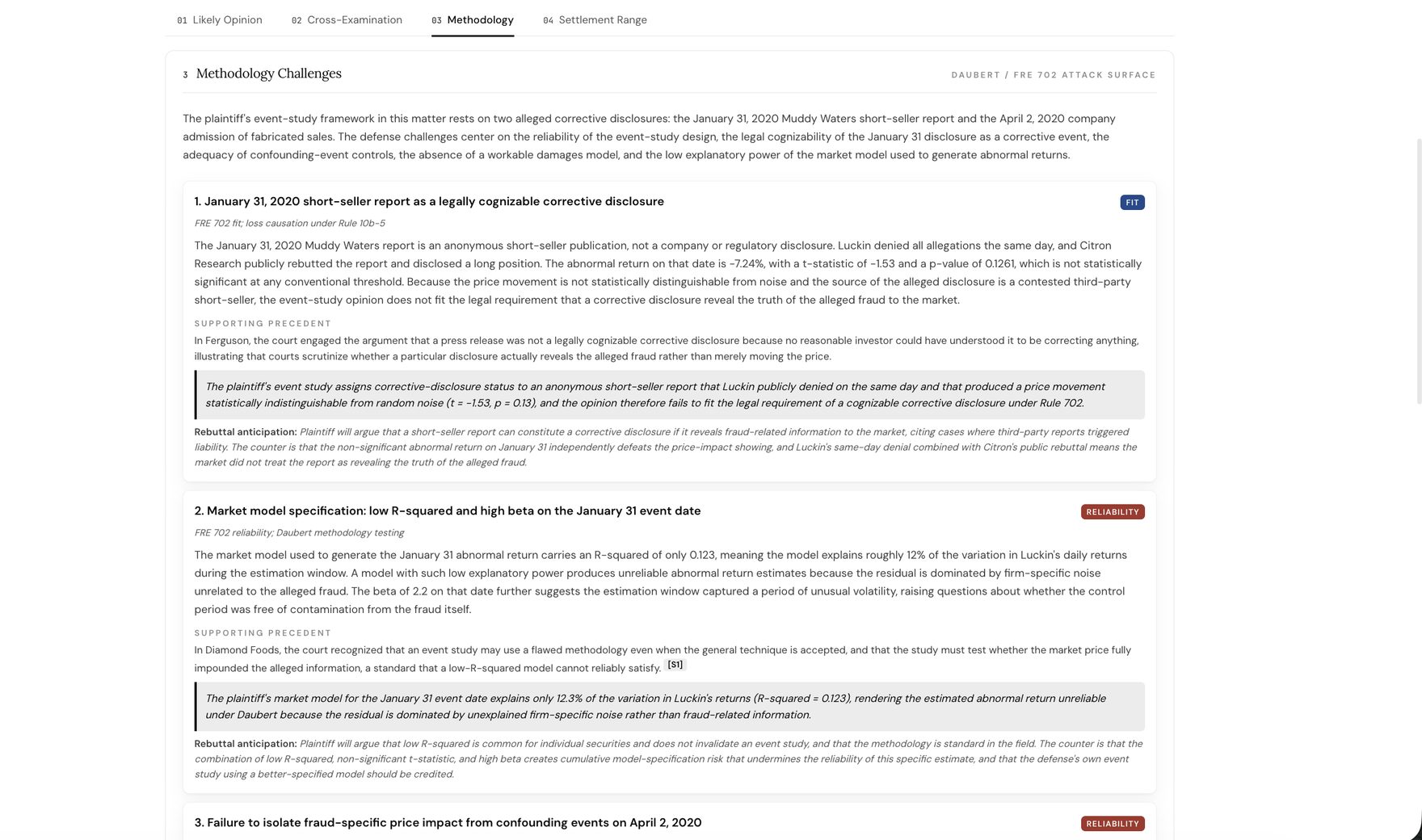
The Rule 702 attack surface, each challenge tagged fit or reliability, with supporting precedent and the rebuttal to anticipate.
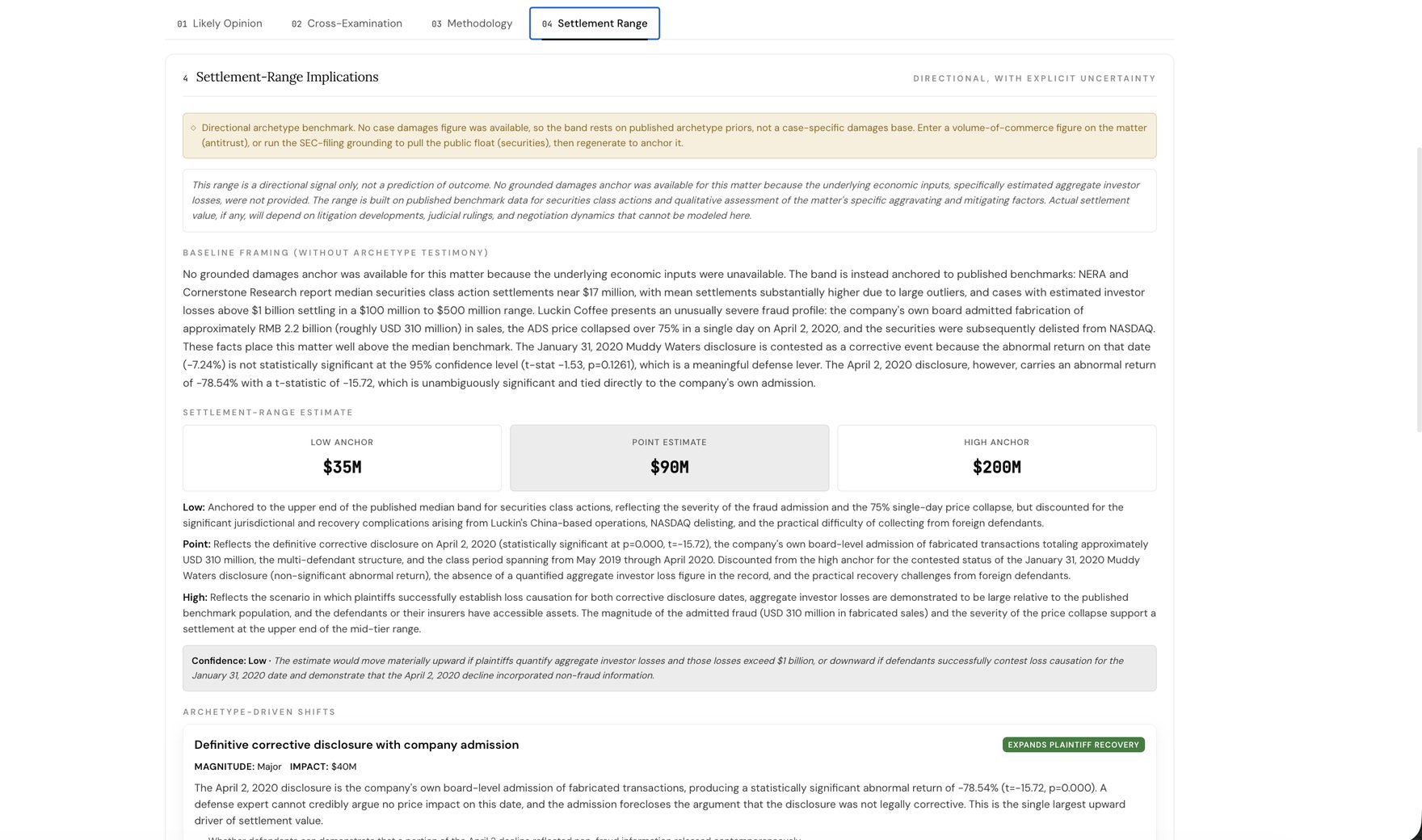
Low, point and high anchors with the reasoning for each, an explicit confidence level, and the named drivers that move the band.
Screens are from a worked public-record example case, which is why the product marks it as an example with a known outcome and offers to score itself against what actually happened.
Read the brief itself.
Every citation opens the full opinion on CourtListener, which is where the run checked it before writing it down.
Likely Opinion
Predicted opinion in the expert's voiceMy event study finds that the January 31, 2020 Muddy Waters short-seller report did not produce a statistically significant abnormal return in Luckin's ADS price, and the April 2, 2020 price collapse, while statistically significant, reflects a confounded disclosure environment that requires careful disaggregation before any damages figure can be accepted. The evidence does not support a single, uncontested corrective-disclosure date that cleanly isolates fraud-related price impact from other contemporaneous value-relevant information.
I conducted an OLS market-model event study using SPY as the benchmark index, with a 120-trading-day estimation window and a gap of 10 days before each event date, consistent with established event-study methodology. For each alleged corrective-disclosure date I estimated the abnormal return, computed the associated t-statistic, and tested statistical significance at the 95 percent confidence level. I also evaluated the Cammer and Unger factors to assess whether Luckin ADSs traded in an informationally efficient market during the class period, a prerequisite for the Basic presumption of reliance. My analysis distinguishes between the contested January 31, 2020 short-seller disclosure and the April 2, 2020 company admission, treating each independently for purposes of price-impact and loss-causation analysis.
The January 31 abnormal return is not statistically significant
My event study finds that on January 31, 2020, the date of the Muddy Waters short-seller report, Luckin's ADS experienced an abnormal return of approximately negative 7.24 percent, but the associated t-statistic of negative 1.53 does not reach the 95 percent confidence threshold (p = 0.1261), meaning the price movement on that date is not statistically distinguishable from normal market noise under my model.
It therefore cannot be established as a corrective disclosure on price impact alone
Because the January 31, 2020 abnormal return is not statistically significant, the Muddy Waters report cannot be established as a legally cognizable corrective disclosure on the basis of price impact alone, and the defense position is reinforced by the fact that Luckin denied the allegations the same day and a prominent investor publicly rebutted the report.
The April 2 abnormal return is significant at any conventional threshold
My event study finds that on April 2, 2020, the date of Luckin's own board disclosure of fabricated transactions, the abnormal return was approximately negative 78.54 percent, with a t-statistic of negative 15.72 (p essentially zero), which is statistically significant at any conventional threshold.
But the April 2 decline is confounded and must be disaggregated
Although the April 2, 2020 abnormal return is statistically significant, the magnitude of that single-day decline, over 75 percent, reflects a confluence of value-relevant information beyond the fraud admission itself, including the simultaneous halt of trading, the prospect of NASDAQ delisting, and broader market conditions during a period of acute volatility, all of which must be disaggregated before the fraud-specific component of the price decline can be attributed to the alleged misrepresentations.
The event study is the right tool, applied under a principled protocol
An event study is the appropriate tool for assessing the loss causation aspect of a securities fraud claim, and the methodology I applied is consistent with that standard, but the selection and classification of event dates must follow a principled protocol grounded in the plaintiff's own allegations rather than post-hoc selection.
The low R-squared limits what a single-index model can attribute
The low R-squared values in my market model (0.123 for January 31 and 0.18 for April 2) indicate that the SPY benchmark explains only a modest fraction of Luckin's daily return variation, which is consistent with a thinly followed foreign private issuer whose price movements are driven substantially by firm-specific and China-market factors not captured by a US equity index, raising questions about the adequacy of any single-index model for this security.
Reasoning arc
I begin from the event study I conducted, which is the standard econometric tool for assessing price impact and loss causation in securities fraud matters. For the January 31, 2020 date, the data show a price decline that is directionally consistent with the plaintiff's theory but falls short of statistical significance at the 95 percent level; I cannot conclude that the Muddy Waters report caused a fraud-related abnormal return distinguishable from noise. For the April 2, 2020 date, the abnormal return is unambiguously significant, but statistical significance is a necessary condition for loss causation, not a sufficient one: the question is whether the entire decline, or only a portion of it, is attributable to the revelation of the alleged fraud as opposed to the trading halt, delisting risk, and contemporaneous market disruption. My opinion is that the evidence does not establish a clean, unconfounded corrective disclosure on January 31, and that the April 2 decline requires disaggregation before any damages figure derived from it can be accepted as reliable. I express no opinion on scienter, materiality as a legal standard, or ultimate liability; those determinations belong to the Court and the trier of fact.
Caveats and limits, stated by the witness
The expert states its own vulnerabilities before opposing counsel does, which is what makes the cross-examination section that follows worth reading:
- My market model uses SPY as the sole benchmark index. Luckin is a China-based issuer whose ADS price may be more closely correlated with Chinese equity indices or consumer-sector benchmarks; omitting a China-market or sector control is a model specification choice that opposing counsel may contest, and I acknowledge it affects the precision of the abnormal return estimates.
- The low R-squared values in my estimation regressions (0.12 to 0.18) mean that a substantial portion of Luckin's daily return variation is unexplained by the market model, which increases the standard error of the abnormal return estimates and reduces the power of the statistical tests, particularly for the January 31 event.
- I have not performed a full Cammer factor analysis on the record available to me; to the extent Luckin ADSs did not trade in an informationally efficient market during the class period, the foundational assumption of the event study and the Basic presumption of reliance would require further examination.
- The April 2, 2020 price decline occurred simultaneously with a trading halt and subsequent delisting proceedings; I have not yet quantified the independent price impact of those structural market events, and any damages model that attributes the full 78 percent abnormal return to the fraud disclosure alone without accounting for those factors would overstate recoverable loss.
- My opinion addresses statistical price impact and does not constitute a complete damages model; a workable, class-wide damages methodology consistent with the theory of liability would require additional analysis that I have not yet performed.
The recorded output of a real run on the public record, in full. Citations open the passage the run relied on, checked against the opinion text on CourtListener.
Read the full brief →Put him on the stand before the deposition.
Your market model for January 31 produced an R-squared of 0.123. Correct?
That figure appears in my report.
A class of expert, never a named individual. Nothing here is filed or offered as testimony.
Ten experts. The bench you’ll face.
Every Section 10(b) case retains a financial economist. Most retain a forensic accountant. Delaware Chancery practice runs through governance, fairness-opinion, and pay-economics experts. The ten experts below cover roughly 85% of the expert types retained in cases of this kind. Two are live today and can be run against your matter now: the defense event-study econometrician for 10(b) damages, and the valuation and fairness-opinion economist for Chancery appraisal and fiduciary work. “In build” means the expert type is on the roster and not yet built. We build them in the order listed, and a firm with a matter in flight can move one up the queue.
Public record. Defined scope.
Each expert is a probabilistic synthesis of how a class of expert testifies. Where a named expert's public corpus is large enough to support precise personalization, the personalization is precise. Where it is not, the expert falls back to the methodology class.
- Prior expert reports filed in publicly-docketed cases via PACER, RECAP, Bloomberg Law, Westlaw
- Prior deposition transcripts through court filings and commercial transcript databases
- Prior trial testimony for cases that went to verdict
- Peer-reviewed academic publications for the academic-testifier subset
- Daubert briefing and rulings that have addressed the methodology in past cases
- Practitioner publications from NERA, Cornerstone, Brattle white papers and conference presentations
- Methodology canon the expert relies on: Cammer/Krogman, NERA event-study standard, Brattle confounding-events doctrine
Supreme Mind never represents an expert as being a real person. Every expert is an expert-class persona, deliberately bounded to the public record.
Matter-first. One brief, grounded in the record.
The deliverable is the Exposure & Settlement Brief: four sections, every supporting quote verified against the public record.
Create a matter
Set up the case and upload documents. The file is extracted and available to the analysis.
Add experts
Add one or more de-identified experts: the opposing expert, or your own retained expert.
Ground it
Ground the analysis in a live-market event study (an OLS market model on real market prices around the disclosure dates) plus extraction from your uploaded case documents.
Generate the brief
Produce the Exposure & Settlement Brief: likely opinion, cross-examination weaknesses, methodology challenges (Daubert / FRE 702), and settlement-range implications.
Verbatim citation verification
Every supporting quote is checked verbatim against public-record sources. Quotes that cannot be verified are dropped, not guessed.
Cross-examination practice simulation
Rehearse the exchange against the expert before the deposition: question, answer, follow-up.
Examine the record
Put a question to the case file, the complaint, the opposing report, the brief, and get an answer cited to the page, read as the opposing expert would. When the record is silent, it says so instead of guessing.
Expert-report stress test
Attack an opposing report for its weak points, or red-team your own retained expert's draft before it is served.
Exports built for the file
Export to Word, a Daubert-motion outline, and a cross-examination outline, plus PDF, copy, and email. Deliverable history is retained.
Named-expert overlay
Where warranted, optionally overlay a specific expert's public judicial record. Admin-controlled, not on by default.
The same thirty days, spent on argument instead of waiting.
Rule 26(a)(2)(D) gives you 30 days to rebut a served expert report. Nothing moves that deadline: not the discovery stay, not the court’s calendar, not us. What changes is how much of the window is left once you understand what you are answering.
- Retaining an expert for the first read · 18 days · $25,000 to $45,000
- Drafting · 7 days
- Moot · 5 days
You reach the moot with a first draft.
- The same read, simulated · Minutes, on day zero
- Building and testing the cross against the expert · 20 days
- Rehearsed moot, then file · 10 days
The first read arrives on day zero, in minutes. You still read the report yourself. What you no longer wait weeks for is an expert telling you where it is weak.
Built for privileged work. Confidentiality is the product.
Matter content is handled as privileged material end to end: where it runs, where it is stored, and what is ever written to a log.
Passwordless sign-in
Magic-link sign-in tied to a named person: a one-time link to a work email. No password to phish or manage.
Firm accounts & admin
Firm accounts with a firm-admin role and self-service team management across multiple devices.
Server-side model
The model runs server-side. The browser never holds an API key.
US-pinned, Zero-Data-Retention
Inference is US-pinned and routed only through Zero-Data-Retention-eligible endpoints. Matter content is not used to train third-party models.
Per-firm US-region isolation
Per-firm data isolation in a US-region database; uploaded documents in a US-region store.
Metadata-only audit; 30-day deletion
Metadata-only audit logging; privileged content is never logged. Deleted matters are removed after a 30-day recovery window.
Pilots add SSO, RBAC, immutable audit logging, and a signed Anthropic data processing addendum (DPA) plus Zero-Data-Retention addendum.
Start on one named matter. Thirty days.
We are opening a small number of first matters with senior trial partners at top-tier plaintiff securities firms. One named matter, your choice. Public-record training data only. Direct line to the founding team throughout.